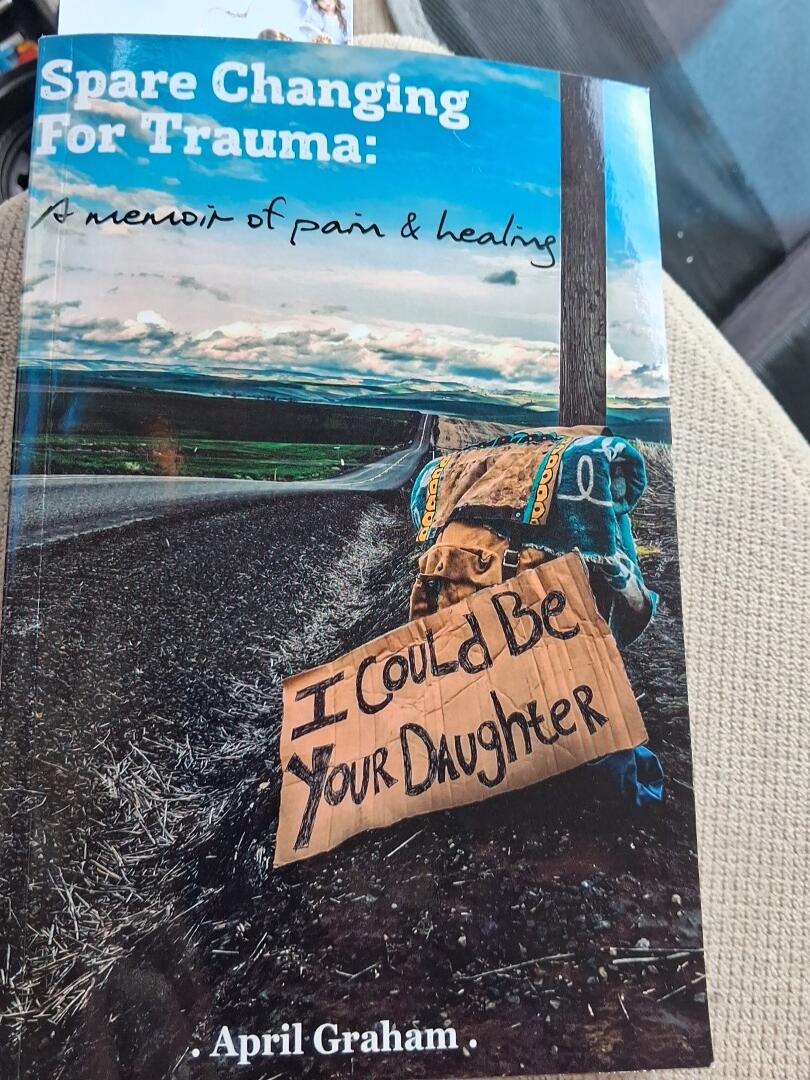
Spare Changing for Trauma: a Memoir of Pain & Healing
• A raw, deeply personal memoir from April Graham’s teenage years living homeless between the ages of 13–18
• Trauma and healing explored alongside real-world herbal practice, without spiritual bypassing or romanticization
• In-depth plant chapters rooted in lived relationship, traditional use, and practical methods
• A second half focused on hands-on ways to work with herbs, emphasizing skill, observation, and respect rather than formulas
243 pages
At a Glance:
Most herbal books teach plants as information — lists, actions, and recipes separated from the lives they’re used in. Spare Changing for Trauma does something different. • The plants are introduced through lived experience, not abstraction — each herb appears in the context of real moments, real wounds, and real survival • Trauma and healing are not separated; the book does not present plants as fixes, but as companions that existed alongside pain • Herbal information is grounded in relationship and use, not perfection or polish • The book does not promise transformation, enlightenment, or closure — it reflects healing as ongoing, imperfect, and human • It prioritizes honesty over aesthetics and lived truth over instructional neatness This is not a reference manual and it is not a feel-good herbal read. It is a book for readers who understand that plants don’t exist outside of life — and that healing doesn’t happen in isolation from the experiences that made it necessary.

Herbalism doesn’t have to be hard — and thousands of women trust April to show them just how simple it can be.
What Women Are Saying
Words from women who have learned alongside April over the years.
More than a biography… more than an herbal resource book…. The clever and very human expression of the author’s experiences gives depth to the “why” of each plant… a healing of both body and soul. I am slowly devouring it and will read it again. It is a truly unique book. I love it so much. It’s like sharing a pot of tea with the author and hearing a story or two. Thank you for this gift, April.

You can hear April in every sentence. Her story telling is vivid and wonderful. While the tales aren't rainbows and sunshine, she spins the herbal wisdom into a sort of happy ending at the end of each tale. And the information shared is actually useful (which i did expect and was not disappointed), clearly expressed and written in a way for all to understand, use and hopefully also share.

I'm not sure where to begin. If you watch April teach, you know she's got something special. Her deep knowledge of herbs and body systems is mind-boggling. She also has a really fun personality and the ability to share things in a way that they can be easily comprehended. This all leads some of us to want to know more about this amazing person. I had to set this book down to cry for a while after the second chapter. There is such brutality and, shining through in tiny ways, such beauty in her story. That she survived the things she did is a great benefit to all of us. I was so drawn in by her experience, I read through those sections like a novel. And I'm more amazed at who and how she is. A person could come away from experienced like that cold and hard and nearly heartless but she is the opposite. She's generous and authentic and truthful and brave. Her grace shines so brightly and I'm absolutely full of gratitudethat I get to learn from her. Then there are the herbs. All I can say is that I have never seen such comprehensive information all in one place before. Some of it is a bit over my head but as I re-read, it's sinking in. This book is an absolute treasure and belongs in every apothecary and library. It's become an immediate favorite.

Common Question, Honest Answers.
This book is less about fixed formulas and more about methods. Rather than presenting rigid recipes meant to be followed exactly, Spare Changing for Trauma teaches foundational ways of working with plants. These methods can be applied to the specific herbs discussed in the book, and they can also be carried forward into a reader’s own herbal practice. • The focus is on learning how to work with plants, not memorizing formulas • Methods are explained in a way that allows flexibility and adaptation • Readers are shown how to prepare herbs using traditional approaches rather than product-style recipes • The emphasis is on relationship, observation, and use — not precision or perfection The intention is to give readers skills they can use beyond the pages of this book, rather than a set of instructions that only apply to one moment or one herb.
Yes — images are included, and they are personal rather than instructional. • Color photographs of April Graham from different periods of her life, included to give context to the memoir portions of the book • Hand-drawn illustrations of plants, offered as artistic representations rather than botanical identification tools • Images that support the storytelling and lived relationship with the plants, not plant identification or field use This book does not include botanical identification photographs or field-guide-style imagery. The visuals are meant to deepen understanding of the story and the relationship with the plants, not to serve as an identification reference. Because this book includes color printing, production costs are higher than April’s other books, which is reflected in the price.